Saturday, May 21, 2011

Augustine of Canterbury

Augustine of Canterbury (circa first third of the 6th century – 26 May 604) was a Benedictine monk who became the first Archbishop of Canterbury in the year 598. He is considered the "Apostle to the English" and a founder of the English Church
Augustine was the prior of a monastery in Rome when Pope Gregory the Great chose him in 595 to lead a mission, usually known as the Gregorian mission, to Britain to Christianize the King Æthelberht of the Kingdom of Kent from his native Anglo-Saxon paganism. In a letter to the patriarch of Alexandria detailing early successes of the mission, Gregory wrote of having sent Augustine and his companions "to the ends of the earth" Kent was probably chosen because it was near the Christian kingdoms in Gaul and because Æthelberht had married a Christian princess, Bertha, daughter of Charibert I the King of Paris who was expected to exert some influence over her husband. Before reaching Kent the missionaries had considered turning back but Gregory urged them on and, in 597, Augustine landed on the Isle of Thanet and proceeded to Æthelberht's main town of Canterbury.
King Æthelberht converted to Christianity and allowed the missionaries to preach freely, giving them land to found a monastery outside the city walls. Augustine was consecrated bishop of the English and converted many of the king's subjects, including thousands during a mass baptism on Christmas Day in 597. Pope Gregory sent more missionaries in 601, along with encouraging letters and gifts for the churches, although attempts to persuade the native Celtic bishops to submit to Augustine's authority failed. Roman bishops were established at London and Rochester in 604, and a school was founded to train Anglo-Saxon priests and missionaries. Augustine also arranged the consecration of his successor, Laurence of Canterbury. The archbishop died in 604 and was soon revered as a saint.

Background to the mission

After the withdrawal of the Roman legions from the province of Britannia in 410, the natives of the province were left to defend themselves against the attacks of the Saxons. Before the withdrawal Britannia had been converted to Christianity and had even produced its own heretic in Pelagius. Britain sent three bishops to the Council of Arles in 314, and a Gaulish bishop went to the island in 396 to help settle disciplinary matters. Material remains testify to a growing presence of Christians, at least until around 360. After the legions left, pagan tribes settled the southern parts of the island, but western Britain, beyond the Anglo-Saxon kingdoms, remained Christian. This native British Church developed in isolation from Rome under the influence of missionaries from Ireland and was centred on monasteries instead of bishoprics. Other distinguishing characteristics were its calculation of the date of Easter and the style of the tonsure haircut that clerics wore. Evidence for the survival of Christianity in the eastern part of Britain during this time includes the survival of the cult of Saint Alban and the occurrence in place names of eccles, derived from the Latin ecclesia, meaning "church". There is no evidence that these native Christians tried to convert the Anglo-Saxons. The invasions destroyed most remnants of Roman civilization in the areas held by the Saxons and related tribes, including the economic and religious structures.
It was against this background that Pope Gregory I decided to send a mission, often called the Gregorian mission, to convert the Anglo-Saxons to Christianity in 595. The Kingdom of Kent was ruled by Æthelberht, who had married a Christian princess named Bertha before 588, and perhaps earlier than 560. Bertha was the daughter of Charibert I, one of the Merovingian kings of the Franks. As one of the conditions of her marriage she had brought a bishop named Liudhard with her to Kent. Together in Canterbury, they restored a church that dated to Roman times—possibly the current St Martin's Church, Canterbury. Æthelberht was a pagan at this point but allowed his wife freedom of worship. One biographer of Bertha states that under his wife's influence, Æthelberht asked Pope Gregory to send missionaries. The historian Ian Wood feels that the initiative came from the Kentish court as well as the queen. Other historians, however, believe that Gregory initiated the mission, although the exact reasons remain unclear. Bede, an 8th-century monk who wrote a history of the English church, recorded a famous story in which Gregory saw fair-haired Saxon slaves from Britain in the Roman slave market and was inspired to try to convert their people. More practical matters, such as the acquisition of new provinces acknowledging the primacy of the papacy, and a desire to influence the emerging power of the Kentish kingdom under Æthelberht, were probably involved. The mission may have been an outgrowth of the missionary efforts against the Lombards.
Aside from Æthelberht's granting of freedom of worship to his wife, the choice of Kent was probably dictated by a number of other factors. Kent was proving to be the dominant power in south-eastern Britain. Since the eclipse of King Ceawlin of Wessex in 592, Æthelberht was the leading Anglo-Saxon ruler; Bede refers to Æthelberht as having imperium (overlordship) south of the River Humber. Trade between the Franks and Æthelberht's kingdom was well established, and the language barrier between the two regions was apparently only a minor obstacle, as the interpreters for the mission came from the Franks. Lastly, Kent's proximity to the Franks allowed support from a Christian area. There is some evidence, including Gregory's letters to Frankish kings in support of the mission, that some of the Franks felt that they had a claim to overlordship over some of the southern British kingdoms at this time. The presence of a Frankish bishop could also have lent credence to claims of overlordship, if Liudhard was felt to be acting as a representative of the Frankish church and not merely as a spiritual advisor to the queen. Frankish influence was not merely political; archaeological remains attest to a cultural influence as well.
In 595, Gregory chose Augustine, who was the prior of the Abbey of St Andrew's in Rome, to head the mission to Kent. The pope selected monks to accompany Augustine and sought support from the Frankish royalty and clergy in a series of letters, of which some copies survive in Rome. He wrote to King Theuderic II of Burgundy and to King Theudebert II of Austrasia, as well as their grandmother Brunhild, seeking aid for the mission. Gregory thanked King Chlothar II of Neustria for aiding Augustine. Besides hospitality, the Frankish bishops and kings provided interpreters and Frankish priests to accompany the mission. By soliciting help from the Frankish kings and bishops, Gregory helped to assure a friendly reception for Augustine in Kent, as Æthelbert was unlikely to mistreat a mission who visibly had the support of his wife's relatives and people. Moreover, the Franks appreciated the chance to participate in mission that would extend their influence in Kent. Chlothar, in particular, needed a friendly realm across the Channel to help guard his kingdom's flanks against his fellow Frankish kings.
Sources make no mention of why Pope Gregory chose a monk to head the mission. Pope Gregory once wrote to Æthelberht complimenting Augustine's knowledge of the Bible, so Augustine was evidently well educated. Other qualifications included administrative ability, for Gregory was the abbot of St Andrews as well as being pope, which left the day-to-day running of the abbey to Augustine, the prior.

Arrival and first efforts

Map showing the kingdoms of Dyfed, Powys, and Gwynedd in the west central part of the island of Great Britain. Dumnonia is below those kingdoms. Mercia, Middle Anglia and East Anglia run across the middle of the island from west to east. Below those kingdoms are Wessex, Sussex and Kent, also from west to east. The northern kingdoms are Elmet, Deira, and Bernicia.
Map of the general outlines of some of the British kingdoms about 600
Augustine was accompanied by Laurence of Canterbury, his eventual successor to the archbishopric, and a group of about 40 companions, some of whom were monks. Soon after leaving Rome, the missionaries halted, daunted by the nature of the task before them. They sent Augustine back to Rome to request papal permission to return. Gregory refused and sent Augustine back with letters encouraging the missionaries to persevere. In 597, Augustine and his companions landed in Kent. They achieved some initial success soon after their arrival: Æthelberht permitted the missionaries to settle and preach in his capital of Canterbury where they used the church of St Martin's for services. Neither Bede nor Gregory mentions the date of Æthelberht's conversion, but it probably took place in 597. In the early medieval period, large scale conversions required the ruler's conversion first, and Augustine is recorded as making large numbers of converts within a year of his arrival in Kent. Also, by 601, Gregory was writing to both Æthelberht and Bertha, calling the king his son and referring to his baptism. A late medieval tradition, recorded by the 15th-century chronicler Thomas Elmham, gives the date of the king's conversion as Whit Sunday, or 2 June 597; there is no reason to doubt this date, although there is no other evidence for it. Against a date in 597 is a letter of Gregory's to Patriarch Eulogius of Alexandria in June 598, which mentions the number of converts made by Augustine, but does not mention any baptism of the king. However, it is clear that by 601 the king had been converted. His baptism likely took place at Canterbury.
Augustine established his episcopal see at Canterbury. It is not clear when and where Augustine was consecrated as a bishop. Bede, writing about a century later, states that Augustine was consecrated by the Frankish Archbishop Ætherius of Arles after the conversion of Æthelberht. Contemporary letters from Pope Gregory, however, refer to Augustine as a bishop before he arrived in England. A letter of Gregory's from September 597 calls Augustine a bishop, and one ten months later says that Augustine had been consecrated on Gregory's command by bishops of the German lands. The historian R. A. Markus discusses the various theories of when and where Augustine was consecrated, and suggests that he was consecrated before arriving in England, but argues that the evidence does not permit deciding exactly where this took place.
Soon after his arrival, Augustine founded the monastery of Saints Peter and Paul, which later became St Augustine's Abbey, on land donated by the king. This foundation has often been claimed as the first Benedictine abbey outside Italy, and that by founding it Augustine introduced the Rule of St. Benedict into England, but there is no evidence that the abbey followed the Benedictine Rule at the time of its foundation. In a letter Gregory wrote to the patriarch of Alexandria in 598, he claimed that more than 10,000 Christians had been baptised; the number may be exaggerated but there is no reason to doubt that a mass conversion took place. However, there were probably some Christians already in Kent before Augustine arrived, remnants of the Christians who lived in Britain in the later Roman Empire. Little literary traces remain of them, however. One other effect of the king's conversion by Augustine's mission was that the Frankish influence on the southern kingdoms of Britain was decreased.
After these conversions, Augustine sent Laurence back to Rome with a report of his success along with questions about the mission. Bede records the letter and Gregory's replies in chapter 27 of his Ecclesiastical History, this section of the History is usually known as the Libellus responsionum. Augustine asked for Gregory's advice on a number of issues, including how to organise the church, the punishment for church robbers, guidance on who was allowed to marry whom, and the consecration of bishops. Other topics were relations between the churches of Britain and Gaul, childbirth and baptism, and when it was lawful for people to receive communion and for a priest to celebrate mass.
Further missionaries were sent from Rome in 601. They brought a pallium for Augustine and a present of sacred vessels, vestments, relics, and books. The pallium was the symbol of metropolitan status, and signified that Augustine was now an archbishop. Along with the pallium, a letter from Gregory directed the new archbishop to ordain 12 suffragan bishops as soon as possible and to send a bishop to York. Gregory's plan was that there would be two metropolitans, one at York and one at London, with 12 suffragan bishops under each archbishop. As part of this plan, Augustine was expected to transfer his archiepiscopal see to London from Canterbury. The move from Canterbury to London never happened; no contemporary sources give the reason, but it was probably because London was not part of Æthelberht's domains. Instead, London was part of the kingdom of Essex, ruled by Æthelberht's nephew Saebert of Essex, who converted to Christianity in 604. The historian S. Brechter has suggested that the metropolitan see was indeed moved to London, and that it was only with the abandonment of London as a see after the death of Æthelberht that Canterbury became the archiepiscopal see. This theory contradicts Bede's version of events, however.

Additional work

Stone statue of a crowned man holding a sceptre.
Æthelberht of Kent statue
In 604, Augustine founded two more bishoprics in Britain. Two men who had come to Britain with him in 601 were consecrated, Mellitus as Bishop of London and Justus as Bishop of Rochester. Bede relates that Augustine, with the help of the king, "recovered" a church built by Roman Christians in Canterbury. It is not clear if Bede meant that Augustine rebuilt the church or that Augustine merely reconsecrated a building that had been used for pagan worship. Archaeological evidence seems to support the latter interpretation; in 1973 the remains of an aisled building dating from the Romano-British period were uncovered just south of the present Canterbury Cathedral. The historian Ian Wood argues that the existence of the Libellus points to more contact between Augustine and the native Christians because the topics covered in the work are not restricted to conversion from paganism, but also dealt with relations between differing styles of Christianity.
Augustine failed to extend his authority to the Christians in Wales and Dumnonia to the west. Gregory had decreed that these Christians should submit to Augustine and that their bishops should obey him, apparently believing that more of the Roman governmental and ecclesiastical organization survived in the Britain than was actually the case. According to the narrative of Bede, the Britons in these regions viewed Augustine with uncertainty, and their suspicion was compounded by a diplomatic misjudgement on Augustine's part. In 603, Augustine and Æthelberht summoned the British bishops to a meeting. These guests retired early to confer with their people, who, according to Bede, advised them to judge Augustine based upon the respect he displayed at their next meeting. When Augustine failed to rise from his seat on the entrance of the British bishops, they refused to recognise him as archbishop. There were, however, deep differences between Augustine and the British church that perhaps played a more significant role in preventing an agreement. At issue were the tonsure, the observance of Easter, and practical and deep-rooted differences in approach to asceticism, missionary endeavours, and how the church itself was organised. Some historians believe that Augustine had no real understanding of the history and traditions of the British church, damaging his relations with their bishops. Also, there were political dimensions involved, as Augustine's efforts were sponsored by the Kentish king, and at this period the Wessex and Mercian kingdoms were expanding to the west, into areas held by the Britons.

Further success

Easier to implement were Rome's mandates concerning pagan temples and celebrations. Temples were to be consecrated for Christian use, and feasts, if possible, moved to days celebrating Christian martyrs. One religious site was revealed to be a shrine of a local St Sixtus, whose worshippers were unaware of details of the martyr's life or death. They may have been native Christians, but Augustine did not treat them as such. When Gregory was informed, he told Augustine to stop the cult and use the shrine for the Roman St Sixtus.
Gregory legislated on the behaviour of the laity and the clergy. He placed the new mission directly under papal authority and made it clear that English bishops would have no authority over Frankish counterparts nor vice versa. Other directives dealt with the training of native clergy and the missionaries' conduct.
The King's School, Canterbury claims Augustine as its founder, which would make it the world's oldest existing school, but the first documentary records of the school date from the 16th century. Augustine did establish a school, and soon after his death Canterbury was able to send teachers out to support the East Anglian mission. Augustine received liturgical books from the pope, but their exact contents are unknown. They may have been some of the new mass books that were being written at this time. The exact liturgy that Augustine introduced to England remains unknown, but it would have been a form of the Latin language liturgy in use at Rome.

Death and legacy
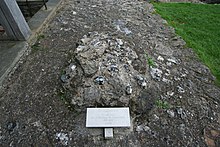
Pile of stones marked with a tag reading "St. Augustine, Site of Grave, First Archbishop of Canterbury
Augustine's gravesite at Canterbury

Before his death, Augustine consecrated Laurence as his successor to the archbishopric, probably to ensure an orderly transfer of office. Although at the time of Augustine's death, 26 May 604, the mission barely extended beyond Kent, his undertaking introduced a more active missionary style into the British Isles. Despite the earlier presence of Christians in Ireland and Wales, no efforts had been made to try to convert the Saxon invaders. Augustine was sent to convert the descendants of those invaders, and eventually became the decisive influence in Christianity in the British Isles. Much of his success came about because of Augustine's close relationship with Æthelberht, which gave the archbishop time to establish himself. Augustine's example also influenced the great missionary efforts of the Anglo-Saxon Church.

 Augustine's body was originally buried in the portico of what is now St Augustine's, Canterbury, but it was later exhumed and placed in a tomb within the abbey church, which became a place of pilgrimage and veneration. After the Norman Conquest the cult of St Augustine was actively promoted. After the Conquest, his shrine in St Augustine's Abbey held a central position in one of the axial chapels, flanked by the shrines of his successors Laurence and Mellitus. King Henry I of England granted St. Augustine's Abbey a six day fair around the date on which Augustine's relics were translated to his new shrine, from 8 September through 13 September.

A life of Augustine was written by Goscelin around 1090, but this life portrays Augustine in a different light than Bede's account. Goscelin's account has little new historical content, mainly being filled with miracles and imagined speeches. Building on this account, later medieval writers continued to add new miracles and stories to Augustine's life, often quite fanciful. These authors included William of Malmesbury, who claimed that Augustine founded Cerne Abbey, the author (generally believed to be John Brompton) of a late medieval chronicle containing invented letters from Augustine, and a number of medieval writers who included Augustine in their romances. Another problem with investigating Augustine's saintly cult is the confusion resulting because most medieval liturgical documents mentioning Augustine do not distinguish between Augustine of Canterbury and Augustine of Hippo, a 4th century saint. Medieval Scandinavian liturgies feature Augustine of Canterbury quite often, however. During the English Reformation, Augustine's shrine was destroyed and his relics were lost.
Today, a Celtic cross marks the spot in Ebbsfleet, Thanet, East Kent, where Augustine is said to have landed, although historian Alan Kay told the BBC in 2005 that Augustine actually landed somewhere between Stonar and Sandwich. According to Kay, Ebbsfleet was not on the coast in the 6th century. The story that Augustine landed there was started in 1884, he said, by a Victorian aristocrat who needed a publicity stunt to draw people to his newly opened tea rooms

Friday, May 20, 2011

Pope ‘s theme for World Day of Peace 2012– “Educating young people in justice and peace”

(May 19, 2011) “Educating young people in justice and peace” is the theme chosen by Pope Benedict XVI for the World Day of Peace 2012, said a communiqué on Thursday from Vatican’s Pontifical Council of Justice and Peace. The Catholic Church celebrates the World Day of Peace annually on the 1st of January. The theme of the 45th World Day of Peace for 2012 states that there is an urgent need in the world today to enhance the important role of new generations in the realization of the common good and in the affirmation of a just and peaceful order, where fundamental rights can be fully expressed and realized. The Papal message says it is the duty of the present generation to prepare the base and create conditions for future generations to act freely and responsibly for a new world. The Papal message affirms that the Church welcomes young people as it sees them as a sign of an ever promising springtime, and holds out Jesus to them as a model of love “who makes all things new.” Pope Benedict’s message calls on all those responsible for public policy, to work for the creation of institutions, laws and environments of life that are permeated by transcendent humanism and offer new generations the opportunities to fully realize themselves by giving them a good education, a decent job and other essentials, to build a civilization of fraternal love, directed towards a more profound awareness of truth, freedom, of love and of justice for all persons.

Wednesday, May 18, 2011

Pope Benedict XVI Prays For Peace In Libya And Syria

VATICAN CITY,  May 15  - Pope Benedict prayed for peace in both Libya and Syria following Sunday's Regina Coeli.

"I continue to follow with great concern the dramatic armed conflict in Libya that has caused a high number of casualties and suffering, especially among the civilian population.

"I renew an urgent appeal that the paths of negotiation and dialogue prevail over those of violence, with the help of international organizations that are working toward finding a solution to the crisis," he stated on May 15.

The Pope's comments came on a day that other key figures called for an intensification of military action in Libya. The head of the U.K.'s armed forces, General Sir David Richards, said he wants to see bombing restrictions on NATO forces eased. He now wants to target direct attacks upon the infrastructure propping up the regime of Colonel Muammar Gaddafi.

NATO's military action is currently guided by the terms of the U.N. resolution which only permit the use of force in protecting civilians. The Pope said he's praying for those innocently caught up in the conflict which has been ongoing since February when rebels first took up arms against Colonel Gaddafi.

"I assure you, also, my sympathy and prayerful commitment with which the Church assists the local population, particularly by religious in hospitals."

The Pope then turned his prayers and thoughts to Syria.

"My thoughts also go to Syria, where it is urgent to restore a partnership geared towards harmony and unity. I ask God that there is no further bloodshed in the homeland of the great religions and civilizations, and urge the authorities and all citizens to spare no effort in seeking the common good and in accommodating the legitimate aspirations for a peaceful future and stability."

Since March, the regime of Syrian President Bashar al-Assad is estimated to have killed over 800 pro-democracy campaigners and imprisoned 10,000 others.

Pope's emissary prays at scenic Matsushima

News photo
Cardinal Robert
An emissary of Pope Benedict XVI on Monday visited a disaster-hit tourist spot in Matsushima, Miyagi Prefecture, to pray for victims of the March 11 earthquake and tsunami.

Cardinal Robert Sarah offered the prayers aboard a sightseeing boat cruising the Matsushima area, which is dotted with small islands devastated by the tsunami.
"People in Matsushima are helping those in neighboring towns who were seriously affected by the disaster even though they themselves are also victims. I was moved to see people helping each other," Sarah said.
The Roman prelate came to Matsushima, one of Japan's three most-celebrated scenic sites, referred to collectively as "Nihon Sankei" (Three Views of Japan) at the invitation of Deputy Mayor Koichi Nishimura.
Nishimura developed connections with the Roman Catholic Church in 1995 when he helped disaster relief activities as a volunteer worker at Kobe's Takatori Catholic Church after the Great Hanshin Earthquake, in which more than 6,400 people died.
Nishimura became aware of the cardinal's impending visit through an email magazine from the church.
"I am rejoicing that my activities 16 years ago are now producing fruits in this manner," Nishimura said. "I hope the cardinal's visit will help promote Matsushima's recovery as a tourist spot."
 
Foreign victim tally at 24

The government has confirmed the deaths of 24 foreigners from the magnitude 9 earthquake and tsunami that struck east and northeast Japan on March 11, but several dozen others are still missing, a senior Foreign Ministry official said Monday.
The ministry has so far listed the dead as nationals of China, Canada, South and North Korea, Pakistan, the Philippines and the United States.
The police have asked the families of those unaccounted for via diplomatic missions in Tokyo to submit DNA samples to help identify the bodies, the official said.
The missing foreigners include nationals of China, South Korea, the Philippines, Indonesia and Vietnam, he added.
In the 1995 Great Hanshin Earthquake, which struck Kobe and its vicinity, around 150 foreigners were among 6,434 victims.
As of Sunday, the death toll from the twin disasters on March 11 had reached 15,057, with 9,121 people still unaccounted for.


Serbian Orthodox Church to Decide on Pope Visit

Whether or not the head of the Roman Catholic Church will arrive in Nis to celebrate 1,700 years since the Edict of Milan was adopted will be known in the next few days, Balkan Insight has learned from a source in the SPC.

The Edict of Milan was signed by emperors Constantine I and Licinius in 313 and announced religious tolerance in the Roman Empire.
Constantine was born in Naissus, modern day Nis.
The Vatican generally says that the Pope will visit countries which have a Catholic minority only with the consent of the majority church in the country.

If the Serbian Orthodox Church agrees to invite Pope Benedict at its annual meeting on Monday, church leaders expect that he will attend the commemoration in Nis.

Serbian Patriarch Irenj, who was previously the Bishop of Nis, stressed even before coming the leader of the SPC that a visit by the pope would help improve relations between Orthodox and Catholic Christians.

If Pope Benedict visits Serbia, it would be the first visit by a pope in years.

It remains unclear, however, whether the bishops will agree to extend an invitation to the pope.

"It's no secret that there are bishops sitting in the council who not only strongly oppose the visit but also sharpen the politics of ecumenism," the source in the SPC said.
On one hand, Serbia wants to maintain top relations with The Vatican because it has not recognised the independence of Kosovo. On the other hand, the source in the SPC said that the stance of other Orthodox churches, especially the Russian Church, plays a major role in deciding whether or not to extend an invitation.

"Some church authorities believe that head of the Serbian Orthodox Church should meet Pope Benedict only after Moscow's Patriarch Cyril meets the pope," the source added.
The idea to invite the pope to Serbia was first "pushed" by the head of a former state union of Serbia and Montenegro, Svetozar Marovic, during his visit to The Vatican in 2003.
The Council is also set to discuss the reorganisation of some dioceses, and the extradition of former bishop Artemije.

Family credits pope with miracle

Christopher Lukasik was building shelves when a metal rod hit his eye, tearing about a third of his optic nerve fibers and leaving everybody from his doctors to his family wondering whether he would ever see again.
Lukasik's mother began to pray to Pope John Paul II, who will be beatified Sunday. The ceremony at Vatican City is the penultimate step towards the late pontiff's sainthood.
"All I could think about is to pray to Pope John Paul II. I just felt him with me and I knew he would be the one that would heal my son," said 67-year-old Joanna Lukasik of Chicago, who grew up near the late pontiff's hometown of Wadowice, Poland. "I was driving to the hospital and I was begging him and crying and begging him to save his vision and that's what happened."
Doctors say he was lucky. Lukasik's mother says it was a miracle.
Lukasik's story is one of thousands of testimonials being collected through a website set up by the Diocesan Tribunal of the Vicariate of Rome. It was created to help Pope John Paul II with his candidacy for Beatification and Canonization.
More than one million people are expected in Rome this weekend for the beatification ceremony, the biggest event at Vatican City since John Paul II's death six years ago. Hundreds of thousands of Catholic faithful will gather in St. Peter's Square to witness the beatification. That will mean Pope John Paul II can be referred to as "blessed" and that one miracle has been confirmed in his or her name. Another miracle is required for canonization, the formal act of declaring someone a saint.
The current pontiff, Pope Benedict XVI, waived the standard five-year waiting period to put John Paul II on the fast track to sainthood. This was an extraordinary response to the millions of mourners who gathered at St. Peter's Square for the pope's funeral crying out, "Santo subito!" (Sainthood now!)
Lukasik's mother credits divine intervention by John Paul II for healing her son, Christopher, after his accident in 2007.
"I know Pope John Paul II did it for him. And that's why always in difficult times I will always pray to him because he was the one that gave me a miracle," she said during an interview with CNN at her Chicago home.
She said for three days there seemed no hope for her son's right eye, which bled continuously.
"Even the specialists couldn't tell what happened. They cannot see it, if he lost vision or not," she said.
Ophthalmology specialist, Dr. Kirk Packo, was one of those who examined the younger Lukasik at Rush University Medical Center in Chicago. He said it was difficult to determine what would happen since Lukasik's eye was full of blood.
He explained that when the metal rod hit his right eye, it spun it around and tore about a third of his nerve fibers.
"Christopher was a hair close to being blind in that eye," Packo said. "He got really lucky."
But Lukasik's mother said it was a miracle, one made possible because of her strong cultural connection with the pontiff and fervent faith in his healing powers.
Joanna Lukasik grew up in John Paul's hometown of Wadowice, Poland, before immigrating to the United States in 1963.
In the 1960s, she said, she volunteered to serve meals at the Urszulanki convent in Rokiciny-Podhalanski. It was there, she says, she got to know Bishop Karol Wojtyła - who would later adopt the name John Paul II as pontiff.
"I remember Bishop Karol Wojtyła used to come to the convent and meet with his friend Bishop Bolesław Kominek," Lukasik said. "He was such a kind soul; you could feel goodness from him. But also I could sense that I was near someone that was truly close to God."
Christopher Lukasik also has own special connection to Pope John Paul II. In 2004, three years before he was nearly blinded, he met the pope during a youth trip.
"When I actually touched his hand,I did feel something I have never felt around any another human being, which in all honesty was probably my first actual spiritual experience," he said. "I could feel some sort of energy in his presence like electricity moving through my body."
Lukasik said that encounter made him realize Pope John Paul II was in the realm of a higher power. Like his mother, he believes this encounter could be the very blessing that helped him overcome his injury.
"If one person suffers trauma and another person suffers trauma, one heals better than the other. It might be a physical thing or it might be something spiritual," he said. "Going into it and actually believing in the church, I'm sure it helped me get my mind off the issues and helped my body heal more."
In the years since his eye injury, Lukasik said he thinks often about the profound impact the pope made on his life.
"I am very proud he is going to be beatified, and it couldn't have happen to a better person," he said. "Maybe people will gain some knowledge as to what he did when he was alive and all the good that he did for the world."

Catholic Church only true church, Vatican says

The Vatican issued a document Tuesday restating its belief that the Catholic Church is the only true church of Jesus Christ.
The 16-page document was prepared by the Congregation for the Doctrine of the Faith, a doctrinal watchdog that Pope Benedict used to head.
Pope Benedict XVI was elected Pope in April 2005.Pope Benedict XVI was elected Pope in April 2005.

(Plinio Lepri/Associated Press)
Formulated as five questions and answers, the document is titled "Responses to Some Questions Regarding Certain Aspects of the Doctrine on the Church."
It says although Orthodox churches are true churches, they are defective because they do not recognize the primacy of the Pope.
"It follows that these separated churches and communities, though we believe they suffer from defects, are deprived neither of significance nor importance in the mystery of salvation," it said.
The document adds that Protestant denominations — called Christian Communities born out of the Reformation — are not true churches, but ecclesial communities.
"These ecclesial communities which, specifically because of the absence of the sacramental priesthood … cannot, according to Catholic doctrine, be called 'churches' in the proper sense," it said.
The document is similar to one written in 2000 by the Pope — who was Cardinal Joseph Ratzinger at the time — that sparked an angry reaction from Protestant groups.
"I suspect there will be some reactions that are rather passionate," said Raphaela Schmid, director of the Becket Institute, a group that advocates religious freedom. "I hope they will not be angry because we all try to understand about each other."
The document is issued by Benedict's successor in doctrinal matters, Cardinal William Levada, and endorsed by the Pope, said Reuters.
The decree comes days after liberal Catholic and Jewish groups spoke out against the Pope's move to authorize the wider use of a traditional Latin mass.
The Tridentine mass includes a prayer for the conversion of Jews. Its use was restricted following the Second Vatican Council from 1962 to 1965.
Pope Benedict issued a decree last week authorizing its broader use in an effort to reconcile with followers of an ultratraditional excommunicated bishop.
The Jewish Anti-Defamation League in New York called it a "body blow to Catholic-Jewish relations."


Source : CBCnews

What Divides Catholics and Protestants?

As Pope Benedict XVI continues with his highly publicized visit to the United States, some may wonder what the major differences are between Catholicism and Protestantism – the two main Christian bodies in the world.

pope

(Photo: AP Images / Gerald Herbert)
President Bush and Pope Benedict XVI walk down the Colonnade of the White House in Washington, Wednesday, April 16, 2008, following an arrival ceremony on the South Lawn.
Perhaps the biggest difference is their views on the sufficiency and authority of Scripture. Traditionally, Protestants believe that the Bible alone is sufficient in teaching man all that is necessary for salvation from sin, and contains the standard in which Christians should measure their behavior.


Catholics, however, do not believe that the Bible alone is enough, and instead hold that the Bible and sacred Roman Catholic traditions are equal in authority, as noted by Got Questions Ministries, which provides biblically-based answers on spiritually-related questions in its Web site, GotQuestions.org.
Roman Catholic doctrines, such as purgatory, praying to the saints, veneration of Mary, have little or no basis in the Scripture, but are based on Roman Catholic traditions.


Another major difference is the office and authority of the pope. There is no equivalent position to the pope in Protestantism because of the belief that no human being is infallible and that Christ alone is the head of the church. Protestants believe that the spiritual authority of the church is based on the Word rather than apostolic succession, and that all believers through the Holy Spirit can understand the Word.
For Roman Catholics, on the other hand, the pope is the “Vicar of Christ,” and stands in the place of Jesus as the visible head of the Church. Therefore, his teachings are considered infallible and effective over all Christians.

Tuesday, May 17, 2011

Christian not feeling safe in Pakistan. By Nazir S Bhatti

After broad day light murder of Punjab Governor Salman Taseer by his bodyguard in Islamabad and threatening marches by Islamists in Pakistan have created feeling of insecurity among millions of Pakistani Christians.

The undue support of lawyer fraternity to killer of Salman Taseer and slow pace of investigation in this high profile murder of a leader who was a strong man of ruling Pakistan Peoples Party have confused poor Pakistani citizens in particular.

There was murder of Mir Murtaza Bhutto in Karachi but his sister Benazir Bhutto was unable to bring her brother’s killers to justice during her premiership. Benazir Bhutto was martyred in Rawalpindi and her husband being President of Pakistan from two years is unable to disclosed her wife’s killers. There is continued episode of murders in PPP leadership but non is punished. The PPP leadership also not seem serious in investigation of assassination of Salman Taseer, who acted to highlight moderate and enlighten Islam agenda and met Asia Bibi, a Christian mother of five, sentenced to death on accusation of blasphemy.

The PPP leadership not dared to take stand on his commitment but took U-Turn on blasphemy law repeal issue to prolong their rule in Pakistan.

What a country, Pakistan is? The Chief Minister of Punjab remains absent from funeral services of Chief Executive of his province on threats of Islamic elements who issued decree that Governor Salman Tasser is “Murtid” after commenting on blasphemy law and Muslims should not participate in funeral of Murtid. The head of Pakistan Peoples Party and President of Pakistan Asif Zardari not bothered to attend last rituals of his dedicated party leader. It seems as “Stay in Rule” is only motive of political parties and Pakistani leaders, for which humanity is on sale also.

The Pakistani Christians were surprised on silence of Federal Minority Minister Shahbaz Bhatti after his appointment from Pakistan Peoples Party PPP. There were always directives from President House in print and electronic media for Federal Minister Shahbaz Bhatti like “Go to Gojra” “Go to Sialkot to visit family of martyr Danish Robert” “Go to Lahore to help murdered housemaid Shazia” “Go to Karachi to meet raped Christian Student Nurse” which created impression that Federal Minority Ministry is run from President House not by Shahbaz Bhatti. We see a big change in statements of Shahbaz Bhatti now, he is put on helm to face blasphemy law saviors while Prime Minister Yousaf Raza Gillani have openly announced not to amend or revise blasphemy laws.

The Prime Minister and President of Pakistan have disowned private bill submitted in national assembly secretariat by PPP leader Sherry Rehman and she is under constant life threat after murder of Salman Taseer, then what’s game of PPP to encourage Shahbaz Bhatti to issue statements to revise blasphemy laws.

Why PPP government not presented revision in blasphemy laws in draft of 18th Amendment when scraped other laws legislated by military ruler Zia-ul-Haq? Why demand of millions of Pakistani Christians was not considered who have been complaining on misuse of blasphemy laws since 1986?

After murder of Salman Taseer and threats to Sherry Rehman from extremist Muslims, common Christian in Pakistan is so fearful that he is thinking to fled from Pakistan.

Turkish EU Minister Visits Assyrian Orthodox Church in Istanbul

Turkey's State Minister and Chief Negotiator for EU talks Egemen Bagis visited Virgin Mary Assyrian Orthodox Church in Beyoglu district in Istanbul on Sunday.
Bagis said that Turkish citizens of Assyrian origin had always worked for Turkey and its development.
Bagis said that Turkey was passing through a different and brand new era and the country was getting stronger.
Turkey had the 6th largest economy in Europe and it had the potential of the fastest growing economy in Europe, he said.
"Our Assyrian brothers and sisters are also pleased with development and transformation in Turkey," he said.
Bagis said that they would improve reform process and democratization in the country.
Metropolitan Bishop of the Assyrian Orthodox Church Yusuf Cetin said that representatives of all political parties visited the church ahead of the general elections. "But State Minister Bagis visited us two years ago. He was the first minister to visit us," he said.
"We always pray for our country's unity, development and for the world peace," Cetin said.

Iraq Assyrian Killed After $100,000 Ransom Demand

Iraqi insurgents killed and mutilated a Christian construction worker whom they had kidnapped over the weekend and demanded $100,000 in ransom for, police and medical officials said on Monday.
Ashur Issa Yaqub, a 29-year-old Chaldean Christian, had been snatched on Saturday in the oil-rich ethnically-mixed northern city of Kirkuk, and is survived by his wife and three children.
"A police patrol found the body of the young Christian man, his head was almost completely cut off," said Kirkuk provincial police chief Major General Jamal Taher Bakr, adding that he believed Al-Qaeda insurgents were behind the gruesome killing.
Provincial health chief Sadiq Omar Rasul confirmed the details, and added that the body "carried traces of torture and the bites of dogs".
A local police officer, speaking on condition of anonymity, said that Yaqub had been found with his head "almost cut off fully, his legs and arms tied together, and his clothes covered in blood."
The kidnappers had demanded $100,000 for Yaqub's release. The average daily wage for a construction worker averages to around 25,000 Iraqi dinars ($21).
Kirkuk, the capital city of the eponymous oil-rich province, is at the centre of a tract of disputed territory claimed by central government authorities in Baghdad and Kurdish regional authorities in Arbil.

Queen of Heaven


The Crowning of the Virgin by the Trinity. Velázquez, 1645
Queen of Heaven is a title given to the Blessed Virgin Mary by Christians, mainly of the Roman Catholic Church, and also, to some extent, in the Anglican, Lutheran, and Eastern Orthodox churches, to whom the title is a (disputed) consequence of the Council of Ephesus in the fifth century, where the Virgin Mary was proclaimed "theotokos" ("God-bearer," "birthgiver of God" or the "one who gives birth to God" among other translations), a title rendered in Latin as Mater Dei, "Mother of God".
The Catholic teaching on this subject is expressed in the papal encyclical Ad Caeli Reginam,[1] issued by Pope Pius XII. It states Mary is called the Queen of Heaven because her Son, Jesus Christ, is the King of Israel and heavenly King of the Universe. In the Hebrew tradition, the mother of the king is the queen (see queen mother). Catholic dogma (Apostolic Constitution Munificentissimus Deus) states that the Virgin Mary, having completed the course of her earthly life, was assumed body and soul into heavenly glory.[2] The title Queen of Heaven has long been a Catholic tradition, included in prayers and devotional literature, and seen in Western art in the subject of the Coronation of the Virgin, from the High Middle Ages, long before it was given a formal dogmatic definition status by the Church. For centuries, Catholics, while reciting the Litany of Loreto were already invoking Mary as "Queen of Heaven".
The Eastern Orthodox churches does not share the Catholic dogma, but has itself a rich liturgical history in honour of Mary. The themes include the annunciation of Mary's transition into heaven through angels, the gathering of apostles around the dying virgin Mary, the funeral procession, the empty tomb and, Mary in heaven.[3] The Orthodox also have a history many of which originate in the Liber de Transitu Mariae (Book of the transition of Mary) dating to the end of the fourth century[4]
Early Protestantism and leading reformers such as Martin Bucer, Johannes Brenz and Bullinger accept Mary's existence in heaven as self-evident as a matter of faith.[5] Johannes Oecolampadius considers Mary as neck of the Mystical Body of Christ and Queen of all Heavenly Powers[6] Martin Luther, in a 1522 sermon at the Feast of the Assumption of Mary, states that she is there, but refuses to discuss how she got there, because of an absence of scriptural proof.[5] In the following theological developments within Protestantism, Marian veneration was largely rejected. Mariology, "a foreign object to Protestant theology, became a means of teaching differences.[7] In the light of this context, the question of Mary as Queen of Heaven was not even raised.
The relation between the Christian title and similar pagan cults is one reason why the Protestant Churches usually avoid such titles as "Queen of Heaven".[8] A related reason is that the only Biblical use of the title "Queen of Heaven" is in Jeremiah (7:18; 44:17ff) denouncing the idolatrous worship of Ashtoreth. There is Scriptural warrant, however, for the Marian title "Queen of Heaven," in the richly allegorical passage in Revelations 12:1 about the pregnant "woman clothed with the sun, with the moon under her feet and a crown of twelve stars on her head" who gave birth to a "son ... who will rule all the nations with an iron sceptre" in the face of the dragon, who was cheated of his prey. The Protestant Churches avoid building doctrine on the Revelation allegory.
Queen of Heaven is a title of Mary, which stimulated veneration expressed in theology, literature and liturgies such as the Liturgy of the Hours, music and art. Since the Council of Ephesus, pictoral presentation of Mary were encouraged, which resulted in numerous presentations of Mary as Regina throughout the ages. Cities in Italy and elsewhere proclaimed the Queen of Heaven to be Queen of Siena, Massa Marittima, San Gimignano as well as Poland and the State of Bavaria[9]
Pope Benedict XVI noted that Mary's acceptance of the divine will is the ultimate reason she is Queen of Heaven. Because of her humble and unconditional acceptance of God's will "God exalted her over all other creatures, and Christ crowned her Queen of heaven and earth."[10]
The title Queen of Heaven was also used in antiquity by various religious systems. In particular, it was used by the prophet Jeremiah, probably in reference to Asherah, a goddess worshipped as the consort of Yahweh in ancient Israel and Judah and in the Temple of Yahweh in Elephantine in Upper Egypt. (see Book of Jeremiah, 7:18 and 44:17). The Hebrew title (מלכת השמים) Malkuth haShamayim appears in the Book of Matthew and Jewish apocryphal writings as βασιλεια των οὐρανων ("The Kingdom of Heaven") which may also be read either as "the Queen of Heaven" or the "Kingdom of Heaven".

Catholicism

Rubens The coronation of the Virgin Mary
According to Catholic doctrine, Mary was assumed into heaven and is with Jesus Christ, her divine Son. Mary should be called Queen, not only because of her Divine Motherhood of Jesus Christ, her only Son, but also because God the Father has willed her to have an exceptional role in the work of the eternal salvation of humanity. The papal encyclical Ad caeli reginam, argues that as Christ, because he redeemed humankind, is its Lord and king by a special title, so the Blessed Virgin Mary is Queen, on account of the unique manner in which she assisted in the redemption of humanity by giving of her own substance, by freely offering him by her singular desire and petition for, and active interest in, human salvation.[11]
Quotes:
  • the main principle on which the royal dignity of Mary rests is without doubt her Divine Motherhood. In Holy Writ, concerning the Son whom Mary will conceive, We read this sentence: "He shall be called the Son of the most High, and the Lord God shall give unto him the throne of David his father, and he shall reign in the house of Jacob forever, and of his kingdom there will be no end," and in addition Mary is called "Mother of the Lord"; from this it is easily concluded that she is a Queen, since she bore a son who, at the very moment of His conception, because of the hypostatic union of the human nature with the Word, was also as man King and Lord of all things. So with complete justice St. John Damascene could write: "When she became Mother of the Creator, she truly became Queen of every creature.".[12]
  • Mary was chosen as Mother of Christ in order that she might become a partner in the redemption of the human race; As Christ, the new Adam, must be called a King not merely because He is Son of God, but also because He is our Redeemer, so, analogously, the Most Blessed Virgin is queen not only because she is Mother of God, but also because, as the new Eve, she was associated with the new Adam.[13]

Mariological basis

Emblem of the Papacy.svg
A series of articles on
Roman Catholic
Mariology
Virgin Mary - Diego Velazquez.jpg
General articles
Mariology • Veneration of the Blessed Virgin • History of Mariology • Mariology of the saints • Mariology of the popes • Encyclicals • Marian Societies
Devotions
Rosary • Scapular • Immaculate Heart • Seven Joys • Seven Sorrows • First Saturdays • Acts of Reparation • Hearts of Jesus & Mary • Consecration to Mary
Dogmas and Doctrines
Mother of God • Perpetual virginity • Immaculate Conception • Assumption • Mother of the Church • Mediatrix • Co-Redemptrix
Expressions of devotion
Art • Hymns • Music • Architecture
Key Marian apparitions
(approved or worthy of belief)
Guadalupe • Miraculous Medal •
La Salette • Lourdes • Pontmain • Laus • Banneux • Beauraing • Fátima • Akita
Queen of Heaven (Latin Regina Caeli) is one of many Queen titles used of the Virgin Mary. The title derived in part from the ancient Catholic teaching that Mary, at the end of her earthly life, was bodily and spiritually assumed into heaven, and that she is there honored as Queen.[14]
The first Mariological definition and basis for the title of Mary Queen of Heaven developed at the Council of Ephesus, where Mary was defined to be the Mother of God. The Council fathers specifically approved this version against the opinion, that Mary is "only" the mother of Jesus. Nobody had participated in the life of her son more, than Mary, who gave birth to the Son of God.[15]

Litany of Loreto

The Litany of Loreto includes several supplications to Mary as Queen. There are two types of statements about the Queen of Heaven.
  • Some refer to the Virgin Mary as theological statements about her queenship.
  • Others indicate more specifically her realm of influence of the virgin as queen of heaven.

Queen conceived without original sin

Queen conceived without original sin refers to the Immaculate Conception of the Virgin Mary, a long held belief which became dogma in 1854. It definitively solved the question, how Mary, fully human and in need of redemption like everybody else, was granted the fullness of God's grace from her very beginning. The dogma teaches, that Mary, the Mother of God, participated from before her birth in the holiness of God through his grace. She did not become a goddess but being without sin, the spiritual mother and new Eve.[16]

Queen assumed into Heaven 

This is the reason she is Queen assumed into Heaven. To Catholics, assumption into heaven refers to the elevation into the heavenly realm, where the saints are with God and his son.[16] Queen assumed into heaven is thus an indication, that Mary's service to the human race was not concluded with the birth of Christ, but continues for all eternity in heaven.[16]

Queen of the Rosary

As Queen of the Rosary, Mary lets the faithful participate in her life with Christ[17] The rosary is a prayer for faith, hope and love, who were all perfected in the Virgin Mary.

Queen of Peace

To Christians Christ is peace. They pray: "May the peace of Christ be with you" Mary is Queen of Peace, because she aided in the reconciliation of humanity with God like nobody else. With the fullness of her person she aided the entry of peace into this world. She is also considered Queen of Peace, because throughout her life, she lived by God's will and not her own. Peace in the Catholic tradition means to do God's will.[16]

Queen of the Angels

In the Catholic tradition as reflected in the Litany of Loreto, angels are messengers of God; angels also praise God. As Mother of God, Mary is more than a messenger and in her Magnificat she praises God. In the heavenly kingdom Mary is seen as Queen of the Angels.

Queen of the Patriarchs

In the Old Testament, patriarchs have a exceptional relation to God. Abraham is even seen as father of the faith (Gen15,5 Rom 4 Hebr 11,8) In the Litany of Loreto, God is not only the God of Abraham, Isaac and Jacob, but also the God of Mary. Only Mary had the complete faith for which she was considered blessed (Luke 1,45)[16] With the title Queen of Patriarchs, the Catholic Church states the continued relevance and position of the Patriarchs of the Old Testament.

Other titles

For similar reasons, Mary, because her prophetic pronouncements in the Magnificat is Queen of Prophets. She is Queen of Apostles, Queen of Martyrs, Queen of Confessors, Queen of Virgins, and Queen of all Saints .[18] As Ever Virgin and immaculate Mother of God who was assumed into heaven, she is closer to God than any other creature[16]
In the classic Roman Catholic Mariology book The Glories of Mary, the author Saint Alphonsus Liguori called the Blessed Virgin Mary the "Gate of Heaven", relying on the writings of Saint Bernard of Clairvaux, another Doctor of the Church. [19]

Feast of Queenship


Coronation of the Salus Populi Romani by Pope Pius XII in 1954
Queenship of Mary is a Marian feast day in the liturgical calendar of the Roman Catholic Church, created by Pope Pius XII. On 11 October 1954, the Pontiff pronounced the new feast in his encyclical Ad caeli reginam. The feast was celebrated on May 31, the last day of the Marian month. In 1969, Pope Paul VI moved the feast day to August 22.
The movement to officially recognise the Queenship of Mary was initially promoted by several Catholic Mariological congresses in Lyon France, Freiburg Germany, and Einsiedeln Switzerland. Gabriel Roschini founded in Rome, Italy, an international society to promote the Queenship of Mary, Pro Regalitate Mariae.[20] Several Popes had described Mary as Queen and Queen of Heaven, which was documented by Gabriel Roschini. Pope Pius XII repeated the title in numerous encyclicals and Apostolic Letters, especially during World War II[21][22][23][24][25][26][27]

Veneration

The Catholic faith states as a dogma, that Mary is assumed into heaven, and is with Jesus Christ, her divine son. Mary should be called Queen, not only because of her Divine Motherhood of Jesus Christ, but also because God has willed her to have an exceptional role in the work of eternal salvation. The encyclical Ad Caeli Reginam argues, that Christ as redeemer is Lord and King. The Blessed Virgin is Queen, because of the unique manner in which she assisted in our redemption, by giving of her own substance, by freely offering Him for us, by her singular desire and petition for, and active interest.[28] Mary was chosen Mother of Christ so she might become a partner in the redemption of the human race; The Catholic Church always venerated the queen of Heaven, according to Pius XII, as
From the earliest ages of the Catholic Church a Christian people, whether in time of triumph or more especially in time of crisis, has addressed prayers of petition and hymns of praise and veneration to the Queen of Heaven And never has that hope wavered which they placed in the Mother of the Divine King, Jesus Christ; nor has that faith ever failed by which we are taught that Mary, the Virgin Mother of God, reigns with a mother's solicitude over the entire world, just as she is crowned in heavenly blessedness with the glory of a Queen.[29]

Queen of Heaven in the Liturgy of the Hours


Crowned statue of Our Lady of Sorrows in the hermitage church of Warfhuizen, Holland, dressed for October.
There are four ancient Marian antiphones, which express the queenship of the Virgin Mary. They are prayed daily in different times of the year as a part of the Liturgy of the Hours. Salve Regina, Ave Regina Caelorum, Alma Redemptoris Mater, and, Regina Caeli.

Salve Regina

The Queen of Heaven is praised in the Salve Regina (Hail Queen), which is sung in the time from Trinity Sunday until the Saturday before the first Sunday of Advent. In the vernacular as a prayer to the Virgin Mary, the Hail Holy Queen is the final prayer of the Rosary. A German Benedictine monk Hermann of Reichenau (1013-1054) allegedly composed it, and originally it appeared in Latin, the prevalent language of the Catholic Church until Vatican II. Traditionally it has been sung in Latin, though many translations exist. These are often used as spoken prayers. In the Middle Ages, Salve Regina offices were held every Saturday[30] In the 13th century, the custom developed, to greet the Queen of Heaven with the Salve Regina, which is considered the oldest of the four Marian antiphons. Several Protestant reformes strongly objected to the Salve and the title Queen of Heaven. As a part of the Catholic Reformation, the Salve Regina was prayed every Saturday by members of the Sodality of Our Lady, a Jesuit Marian congregation.

Ave Regina Caelorum

Ave Regina Caelorum (Hail, Queen of Heaven) is a early Marian antiphon, praising Mary, the Queen of Heaven It is traditionally said or sung after each of the canonical hours of the Liturgy of the Hours. The prayer is used especially after Compline, the final canonical hour of prayer before going to sleep. It is said from the Feast of the Presentation (February 2) through Wednesday of Holy Week. It used to be sung at the feast of the Assumption of Mary. Ave Regina Caelorum dates back in a different musical intonation to the 12th century.[31] Today's version is slightly different from a 12th century intonation. The Ave Regina Caelorum has four parts: Ave, Salve, Gaude and Vale ( in English: Hail rejoice, farewell). It was used for processions in honour of the Queen of Heaven.[32] Ave Regina Caelorum received numerous musical versions, a famous of which was composed in 1773 by Joseph Haydn.[33]

Alma Redemptoris Mater


Coronation of Mary by Fra Angelico
Alma Redemptoris Mater ("Loving Mother of our Savior) ", is recited in the Catholic Church at compline only from the first Sunday in Advent until the Feast of the Purification (February 2). Continuing theological discussions exist as to the origin and excaxt timing of this Marian antiphon. It has two equal parts. The Virgin Mary is loving Mother of the Savior, ever virgin with a very high position in heaven. May she listen to her people with mercy in their need for her help. Alma Redemptoris Mater,[34] The Latin text is rather short:
Alma Redemptoris Mater, quae pervia caeli,
Porta manes, et stella maris, succurre cadenti,
Surgere qui curat, populo: tu quae genuisti,
Natura mirante, tuum sanctum Genitorem
Virgo prius ac posterius, Gabrielis ab ore
Sumens illud Ave, peccatorum miserere.

Regina Coeli

Regina Coeli (Queen of Heaven) is an anthem of the Roman Catholic Church which replaces the Angelus at Eastertide (from Holy Saturday until the Saturday after Pentecost); it is named for its opening words in Latin. Regina Coeli was subject of numerous intonations throughout the centuries by known and unknown composers. Not all attributions are correct however, as an often quoted Regina Coeli by Joseph Haydn had other authors.[33] Of unknown authorship, the anthem was in Franciscan use in the first half of the 13th century. Together with three other Marian anthems, it was incorporated in the Minorite Roman Curia Office, which the Franciscans soon popularized everywhere, and which by order of Pope Nicholas III (1277–1280) replaced all the older breviaries in the churches of Rome.[35]

Biblical Basis


Mary crowned with stars. A reflection of the biblical image in Revelation 12. Statue by Attard

In the New Testament, the title has several biblical sources. Mary is mother of the messianic king. Luke 1:32 says of Jesus, He will be great, and will be called the Son of the Most High; and the Lord God will give to him the throne of his father David. He will rule over the house of Jacob forever and his reign will be without end. It is therefore held in Christianity, that the throne of King David has passed to Jesus. The biblical precedent of ancient Israel is that the mother of the king becomes the Queen Mother.[36] Since Jesus is heavenly king, of the lineage of David and Solomon, many see Mary as Queen Mother.
The Roman Catholic Church also sees Mary crowned as queen in heaven in the Book of Revelation 12, verses 1-5: "1 A great and wondrous sign appeared in heaven: a woman clothed with the sun, with the moon under her feet and a crown of twelve stars on her head. 2 She was pregnant and cried out in pain as she was about to give birth. 3 Then another sign appeared in heaven: an enormous red dragon with seven heads and ten horns and seven crowns on his heads."

Giacomo di Mino, 1340-1350
For Catholics, the reference to the ark of the covenant immediately prior to this passage(chapter 11, verse 19)confirms the woman's identification with Mary as she is seen as the ark of the "new covenant" bearing the Word of God (Christ) in her womb as the old ark carried the Ten Commandments. Catholics interpret Psalm 45, "A Song Celebrating the King's Marriage", refers to the Messiah, to suggest in verse nine, that Jesus, the Messiah, would have a queen at his right hand. Although Mary was Jesus' mother, she is often portrayed as that queen. Other views are that Psalm 45 refers to the marriage of Jesus to His people – i.e., the church which is called the "Bride of Christ" or that Psalms 45 is simply a celebration upon the marriage of an earthly king, giving thanks to God but not referring to the Messiah. It is also believed by those assigning a special significance to Mary, and believing in her Annunciation, that in Luke 1:26-35 of the New Testament the Archangel Gabriel seems to praise Mary, although she would otherwise be inferior to him.
The Catholic Church generally reasons, that the bible speaks of the mother of Jesus as: "a woman clothed with the sun, and the moon under her feet, and on her head a crown of twelve stars" - (Revelation 12:1). As Mary is a perfect model of the Church, she also represents the Church as a whole.[37] However, non-Catholic Bible scholars interpret these verses to be not referring to Mary, but rather to Israel or Judah. The Bible generally refers to nations and tribes as female characters, as in Matthew 2:18 & Revelation 17. And since Jesus is the Alpha and Omega(Revelation 22:13) and through Him all things were created(Colossians 1:15-17), Mary is not considered to be the Queen of Heaven. This is still a controversial subject in Christianity, not accepted by all denominations.
In the Old Testament the term "queen of heaven" appears in a context unrelated to Mary. The prophet Jeremiah writing circa 628 BC refers to a "queen of heaven" in chapters 7 and 44 of the Book of Jeremiah when he scolds the people for having "sinned against the Lord" due to their idolatrous practices of burning incense, making cakes and pouring out drink offerings to her. This title was probably given to Asherah a Caananite idol and goddess worshipped in ancient Israel and Judah.[38] For a discussion of "queen of heaven" in the Old Testament, see Queen of heaven (Antiquity).

Queen of Heaven in art


Earliest known (6th century) Roman depiction of Santa Maria Regina (Saint Mary the Queen), Santa Maria Antiqua church, Rome.
Early Christian art show Mary in an elevated position. She carries her divine son in her hands, or holds him. After he ascended into heaven, he reigns in divine glory. Mary, his mother, assumed into heaven by her son, participates in his heavenly glory.
The earliest known Roman depiction of "Santa Maria Regina" depicting the Virgin Mary as a Queen dates to the 6th century and is found in the modest church of Santa Maria Antiqua (i.e. ancient St. Mary) built in the 5th century in the Forum Romanum. Here the Virgin Mary is unequivocally depicted as an empress.[39][40][41] As one of the earliest Roman Catholic Marian churches, this church was used by Pope John VII in the early 8th century as the see of the bishop of Rome. Also in the 8th century, the Second Council of Nicaea decreed that such pictures of Mary should be venerated.[42]
In the early 16th century, Protestant reformers began to discourage Marian art, and some like John Calvin or Zwingli even encouraged its destruction. But after the Council of Trent in the mid-16th century confirmed the veneration of Marian paintings for Catholics, Mary was often painted as a Madonna with crown, surrounded by stars, standing on top of the world or the partly visible moon. After the victory against the Turks at Lepanto, Mary is depicted as the Queen of Victory, sometimes wearing the crown of the Habsburg empire.[43] National interpretations existed in France as well, where Jean Fouquet painted the Queen of Heaven in 1450 with the face of the mistress of King Charles VII[9] Statues and pictures of Mary were crowned by kings in Poland, France, Bavaria, Hungary and Austria,[9] sometimes apparently using crowns previously worn by earthly monarchs - a surviving small crown presented by Margaret of York seems to have been that worn by her at her wedding to Charles the Bold in 1463. A recent coronation was that of the picture of the Salus Populi Romani in 1954 by Pius XII. The veneration of Mary as queen continues into the 21st Century, but artistic expressions do not have the leading role as in previous times[9]
Artworks, including paintings, mosaics and carvings of the coronation of Mary as Queen of Heaven, became increasingly popular from the 13th century onward. Works follow a set pattern, showing Mary kneeling in the heavenly court, and being crowned either by Jesus alone, or else by Jesus and God the Father together, with the Holy Spitit, usually in the form of a dove, completing the Trinity. The Coronation of Mary is almost entirely a theme of western art. In the Eastern Orthodox Church, although Mary is often shown wearing a crown, the coronation itself never became an accepted artistic subject

Paschal Baylon

Saint Paschal Baylon (or Pascal Baylon) (24 May 1540 – 17 May 1592) was a Spanish friar and is a saint in the Roman Catholic Church. He is the patron saint of Eucharistic congresses and Eucharistic associations.
  
Life
He was born at Torrehermosa, in the Kingdom of Aragon, on 24 May 1540, on the Feast of Pentecost, called in Spain "the Pasch (or "Passover") of the Holy Ghost", whence the name Paschal. His parents, Martin Baylon and Elizabeth Jubera, were poor peasants. He spent his youth as a shepherd. He would carry a book with him and beg passersby to teach him the alphabet and to read, and as he toiled in the fields he would read religious books.
In around 1564, he joined the Reformed Franciscan Order (Alcantarine Reform) as a lay brother. He chose to live in poor monasteries because, he said, "I was born poor and am resolved to die in poverty and penance." He lived a life of poverty and prayer, even praying while working, for the rest of his life.
He was a mystic and contemplative, and he had frequent ecstatic visions. He would spend the night before the altar in prayer many nights. At the same time, he sought to downplay any glory that might come from this piety. He died on May 17, which is his current feast day, in 1592.

Veneration

Sepulchre of Paschal Baylon, Villareal.
 His tomb in the Royal Chapel in Villareal in the old province of Valencia, where he died, immediately became an object of pilgrimage. Beatified by Paul V in 1618, he was canonized by Alexander VIII on October 16, 1690. The saint is usually depicted in adoration before a vision of the Eucharist.
Forty years before he was canonized, an indigenous Guatemalan claimed to have had a vision of a sainted Paschal Baylon, appearing as a robed skeleton. This event became the basis of the heterodox tradition of San Pascualito.[1]
Paschal Baylon was enlisted in the Church's struggle against Modernism, part of which was through increasing devotion towards the Sacrament of the Eucharist; Pope Leo XIII[2] proclaimed Saint Paschal Baylon, the "seraph of the Eucharist", Patron of eucharistic congresses and all contemporary and future eucharistic associations. Christian Art usually depicts him wearing the Franciscan habit and bearing a Monstrance, signifying his devotion to the Holy Eucharist.
During the Red Terror at the time of the Spanish Civil War his grave was desecrated and his relics burned by anticlerical leftists.