Paul the Apostle, also called the Apostle Paul, Saul of Tarsus, and Saint Paul (c. AD 5 – c. AD 67), was one of the most influential early Christian missionaries, with his writings forming a considerable portion of the New Testament. His influence on Christian thinking has been of utmost significance due to his role as a prominent apostle of Christianity during the spreading of the Gospel through early Christian communities across the Roman Empire.

Along with Simon Peter and James the Just he was one of the most prominent arly Christian leaders He was also a Roman citizen—a fact that afforded him a privileged legal status with respect to laws, property, and governance.
Thirteen epistles in the New Testament are attributed to Paul. His authorship of seven of the thirteen is questioned by modern scholars. Augustine of Hippo developed Paul's idea that salvation is based on faith and not "Works of the Law"] Martin Luther's interpretation of Paul's writings heavily influenced Luther's doctrine of sola fide.
Paul's conversion dramatically changed the course of his life. Through his missionary activity and writings he eventually transformed religious belief and philosophy around the Mediterranean Basin. His leadership, influence and legacy led to the formation of communities dominated by Gentile groups that worshiped the God of Israel, adhered to the Judaic "moral code", but relaxed or abandoned the "ritual" and dietary obligations of the Mosaic law all on the basis of Paul's teachings of the life and works of Jesus Christ and his teaching of a new covenant (or "new testament") established through Jesus' death and resurrection. The Bible does not Paul on chapel record Paul's death.

Conversion of Saint Paul, a fresco by Michelangelo.
The main source for historical information about Paul's life is the material found in several of his epistles and the Book of Acts. However, these epistles contain comparatively little information about Paul's past. The Book of Acts also recounts Paul's career but leaves several parts of Paul's life out of its narrative, such as his (alleged) execution in Rome. Scholars such as Hans Conzelmann and 20th century theologian John Knox (not to be confused with the 16th century John Kn) dispute the historical reliability of the Acts of the Apostles. Paul's own account of his background is found particularly in Galatians. According to some scholars, the account in Acts of Paul visiting Jerusalem contradicts the account in Paul's letters. (See the Acts of the Apostles article). Some scholars consider Paul's accounts to be more reliable than those found in Acts.
Names
Paul shares his original Hebrew name Saul (Hebrew: שָׁאוּל, Modern Sha'ul Tiberian Šāʼûl ; "asked for, prayed for"), with the biblical King Saul, a fellow Benjaminite and the first king of Israel, who was replaced by King David, of the tribe of Judah. Usage of "Paul" is first recorded in Acts when he begins his first missionary journey into a new territory. In Acts 13:6-13, we are told of Paul speaking to Sergius Paulus, a Roman official. Along with being ethnically Jewish, Paul was born a Roman citizen Acts 22:28. "Paul" was part of his three-part Roman name.
In Ancient Greek: Σαούλ (Saul), Σαῦλος (Saulos), and Παῦλος (Paulos), In Latin Paulus or Paullus, in Hebrew: שאול התרסי Šaʾul HaTarsi (Saul of Tarsus)
Prior to conversion

James Tissot - Saint Paul - Brooklyn Museum.
Paul, whose Hebrew name was Saul,[17] claimed to be "of the stock of Israel, of the tribe of Benjamin, an Hebrew of the Hebrews; as to the law, a Pharisee."[Phil. 3:5] Paul's "sister's son" is mentioned in Acts 23:16. Acts identifies Paul as from the Mediterranean city of Tarsus (in present-day south-central Turkey), well-known for its intellectual environment. Acts also quotes Paul indirectly referring to his father by saying he was "a Pharisee, the son of a Pharisee".[Acts 23:6] Paul refers to his mother in Romans 16:13, among those at Rome. Paul confesses that "beyond measure" he persecuted the "church of God" prior to his conversion. Paul was born a citizen of the city Tarsus as well as a citizen of Rome, an honor not often granted to "outsiders." It is likely that Paul's family purchased the Tarsian citizenship with money earned from their trade. His family were tent-makers, a trade that Paul uses to support himself throughout his ministry. Scripture does not say how Paul's family acquired a Roman citizenship but scholars speculate that his father or grandfather may have been honored with it for some sort of military service.
Although born in Tarsus, he was raised in Jerusalem "at the feet of Gamaliel", who is considered to be "one of the greatest teachers in all the annals of Judaism", and whose level headed advice to the council in Acts 5:34-39, to "refrain" from slaying the disciples, is in great contrast to the rashness of his student Saul, who went on a rampage, after the death of Stephen, persecuting the "saints".(Acts 9:13; Acts 26:10)
Conversion and mission
Main article: Conversion of Paul

Geography relevant to Paul's life, stretching from Jerusalem to Rome.
Paul's conversion can be dated to 31 - 36 by his reference to it in one of his letters. According to the Acts of the Apostles, his conversion (or metanoia) took place on the road to Damascus where he claimed to have experienced a vision of the resurrected Jesus after which he was temporarily blinded.
Post-conversion testimony
In the opening verses of Romans 1, Paul provides a litany of his own apostolic claim and his post-conversion convictions about the risen Christ:- Paul describes himself as
- a servant of Christ Jesus
- called to be an apostle
- set apart for the gospel of God
- Paul describes Jesus as
- having been promised by God "beforehand" through his prophets in the holy Scriptures
- being the Son of God
- having biological lineage from David ("according to the flesh")
- having been declared to be the Son of God in power according to the Spirit of holiness by his resurrection from the dead
- being Jesus Christ our Lord
- the One through whom we have received grace and apostleship to bring about the obedience of faith for the sake of his name among all the nations, "including you who are called to belong to Jesus Christ."
Paul's writings give some insight into his thinking regarding his relationship with Judaism. He is strongly critical both theologically and empirically of claims of moral or lineal superiority of Jews while conversely strongly sustaining the notion of a special place for the Children of Israel.
Paul asserted that he received the Gospel not from any person, but by a personal revelation of Jesus Christ. Paul claimed independence from the Jerusalem community (possibly in the Cenacle), but was just as quick to claim agreement with it on the nature and content of the gospel. What is remarkable about such a conversion is the changes in the thinking that had to take place. He had to change his concept of who the messiah was, particularly the absurdity of accepting a crucifed messiah. Perhaps more challenging was changing his conception of the ethnic superiority of the Jewish people. There are debates as to whether Paul understood himself as commissioned to take the gospel to the Gentiles at the moment of his conversion.
Early ministry

The house believed to be of Ananias of Damascus in Damascus.

Bab Kisan, believed to be where Paul escaped from persecution in Damascus.
After his conversion, Paul went to Damascus, where Acts states he was healed of his blindness and baptized by Ananias of Damascus. Paul says that it was in Damascus that he barely escaped death. Paul also says that he then went first to Arabia, and then came back to Damascus. Paul's trip to Arabia is not mentioned anywhere else in the Bible, and some suppose he actually travelled to Mt. Sinai for meditations in the desert. He describes in Galatians how three years after his conversion he went to Jerusalem. There he met James and stayed with Simon Peter for 15 days.
Paul asserted that he received the Gospel not from any person, but by the revelation of Jesus Christ.[Gal. 1:11–12]. Paul claimed almost total independence from the Jerusalem community. and yet appeared eager to bring material support from the various budding Gentile churches that he planted to Jerusalem. In his writings, Paul persistently used the persecutions he claimed to have endured, in terms of physical beatings and verbal assaults, to claim proximity and union with Jesus and as a validation of his teaching.
Paul's narrative in Galatians states that 14 years after his conversion he went again to Jerusalem.[Gal. 2:1–10] It is not completely known what happened during these so-called "unknown years," but both Acts and Galatians provide some partial details. At the end of this time, Barnabas went to find Paul and brought him back to Antioch. [Acts 11:26]
When a famine occurred in Judea, around 45–46, Paul and Barnabas journeyed to Jerusalem to deliver financial support from the Antioch community. According to Acts, Antioch had become an alternative center for Christians following the dispersion of the believers after the death of Stephen. It was in Antioch that the followers of Jesus were first called "Christians."[Ac. 11:26]
First missionary journey
The author of the Acts arranges Paul's travels into three separate journeys. The first journey,[Ac 13-14] led initially by Barnabas, takes Paul from Antioch to Cyprus then southern Asia Minor (Anatolia), and back to Antioch. In Cyprus, Paul rebukes and blinds Elymas the magician[Ac 13:8-12] who was criticizing their teachings. From this point on, Paul is described as the leader of the group.
They sail to Perga in Pamhylis. John Mark leaves them and returns to Jerusalem. Paul and Barnabas go on to Pisidian Antioch. On the Sabbath they go to the Synagogue. The leaders invite them to speak. Paul reviews Israelite history from life in Egypt to King David. He introduces Jesus as a descendant of David brought to Israel by God. He said that his team came to town to bring the message of salvation. He recounts the story of Jesus' death and resurrection. He quotes from the Hebrew scriptures to show that Jesus was the promised Messiah who brought them forgiveness for their sins. Both the Jews and the 'God-fearing' Gentiles invited them talk more the next Sabbath. At that time almost the whole city gathered. This upset some influential Jews who spoke against them. Paul used the occasion to announce a change in his mission which from then on would be to the Gentiles. [Ac 13:13-48]
Second missionary journey
Paul leaves for his second missionary journey from Jerusalem, in late Autumn 49, where they were having a council with other apostles, and where the circumcision question was lifted up. On their trip around the Mediterranean sea, Paul and his companion Barnabas stopped in Antioch where they had a sharp argument about taking John Mark with them on their trips. It is mentioned in the book of Acts that John Mark had left them in a previous trip and went home; Paul did not think he was ready for this kind of evangelism. Paul and Barnabas decided to separate. Barnabas ended up taking John Mark with him, while Silas joined Paul.
Paul and Silas traveled to a lot of different cities such as Tarsus, Derbe and Lystra. In Lystra, they met Timothy, a disciple who was spoken well of, and decided to take him with them. The Church kept growing, adding believers, and strengthening their faith daily (Acts 16:5). In Philippi, men who were not happy about the conversion of their slave turned the city against the missionaries and Paul and Silas were put in jail. After a miraculous earthquake, the gates of the prison fell apart and Paul and Silas were able to escape; this event led to the conversion of the jailor. They continued traveling, went by Berea and Athens where Paul preached to the Jews and Greeks; and in Corinth where Paul met Aquila and Priscilla who became faithful believers and helped Paul through his other missionary journeys. The couple followed Paul and his companions to Ephesus, and stayed there to start one of the strongest, and most faithful Church at that time. In 52, the missionaries sailed to Caeserea to greet the Church there, and traveled down to Antioch to stay there for about 1 year before leaving again on their third missionary journey.
Third missionary journey

Paul began his third missionary journey by traveling all around the region of Galatia and Phrygia to strengthen, teach and rebuke the believers. When he arrived in Ephesus, he stayed there for a little less than 3 years and performed a lot of miracles, like healing people and casting demons out. Then he went through Macedonia, went up to Greece, and as he was getting ready to leave for Syria, he changed his plans because of Jews who had made a plot against him, and had to go back through Macedonia. He finished his trip in Caeserea.
Journey to Rome
Paul and his companions went on to Rome, which was probably their last missionary journey, in 60. They started in Jerusalem where the brothers there received them joyfully. Paul was beaten and almost killed before he was arrested and kept as a prisoner in Caesarea for about one year and a half even before starting his journey. He was transferred to Rome after his request and was released after the Roman commander realized that he was born a Roman citizen. Paul continued to preach in Rome and possibly traveled to other countries like Spain and Britain before he died as a martyr in 68AD.
Persecution
Many plots were made against Paul in the last years of his life, especially by Jews who would stir the crowd and excite them when Paul was preaching. He was beaten more than once, and put in prison. He was persecuted in every one of his missionary journeys. He was persecuted because of a “lack of understanding, preconceptions, irritations and provocation.” The message of a risen Christ and Savior was aggravating for Jews as well as many pagan believers. During his first missionary journey, Paul was stoned in the city of Lystra for healing a crippled man. Some Jews dragged him out of the city thinking he was dead but when his disciples came around him, he miraculously got up and went into the city. Paul was also put in prison while he was in Philippi and also in Jerusalem.
Council of Jerusalem
Main article: Council of Jerusalem

Icon of James the Just, whose judgement was adopted in the Apostolic Decree of Acts 15:19-29, c. 50.
Most scholars agree that a vital meeting between Paul and the Jerusalem church took place some time in the years 48 to 50,[11] described in Acts 15:2 and usually seen as the same event mentioned by Paul in Galatians 2:1.[11] The key question raised was whether Gentile converts needed to be circumcised.[44] At this meeting, Paul claims in his letter to the Galatians that Peter, James, and John accepted Paul's mission to the Gentiles. See also Circumcision controversy in early Christianity.
Jerusalem meetings are mentioned in Acts, in Paul's letters, and some appear in both. For example, the Jerusalem visit for famine relief[Acts 11:27–30] apparently corresponds to the "first visit" (to Cephas and James only).[Gal. 1:18–20][45] F. F. Bruce suggested that the "fourteen years" could be from Paul's conversion rather than the first visit to Jerusalem.
Incident at Antioch
Main article: Incident at Antioch
Despite the agreement achieved at the Council of Jerusalem, as understood by Paul, Paul recounts how he later publicly confronted Peter, also called the "Incident at Antioch" over Peter's reluctance to share a meal with Gentile Christians in Antioch.
Writing later of the incident, Paul recounts: "I opposed [Peter] to his face, because he was clearly in the wrong". Paul reports that he told Peter: "You are a Jew, yet you live like a Gentile and not like a Jew. How is it, then, that you force Gentiles to follow Jewish customs?"[Gal. 2:11–14] Paul also mentions that even Barnabas (his traveling companion and fellow apostle until that time) sided with Peter.
The final outcome of the incident remains uncertain. The Catholic Encyclopedia states: "Paul's account of the incident leaves no doubt that Peter saw the justice of the rebuke." In contrast, L. Michael White's From Jesus to Christianity claims: "The blowup with Peter was a total failure of political bravado, and Paul soon left Antioch as persona non grata, never again to return."
The primary source for the Incident at Antioch is Paul's letter to the Galatians.
Visits to Jerusalem in Acts and the epistles
This table is adapted from White, From Jesus to Christianity. Note that the matching of Paul's travels in the Acts and the travels in his Epistles is done for the reader's convenience and is not approved of by all scholars.| Acts | Epistles |
|
|
|
|
| |
|
|
|
|
Resumed mission
Around 50-52, Paul spent 18 months in Corinth. The reference in Acts to proconsul Gallio helps ascertain this date (cf. Gallio inscription). Here he worked with Silas and Timothy.
After Corinth, the next major center for Paul's activities was Ephesus. Ephesus was an important center for early Christianity from the year 50, see also Early centers of Christianity#Western Anatolia. From 52 to 54, Paul lived here, working with the congregation and apparently organizing missionary activity into the hinterlands. Paul's time here was marked by disturbances and possibly imprisonment. Finally, he was forced to leav
Next, he traveled to Macedonia before going probably to Corinth for three months (56-57) before his final visit to Jerusalem. Though Paul wrote that he visited Illyricum, he meant what would now be called Illyria Graeca that was part of the Roman province of Macedonia, which is now modern day Albania.
Arrest and death
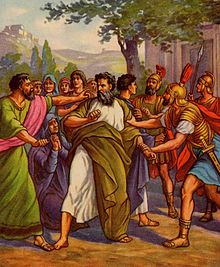
Saint Paul arrested, early 1900s Bible illustration.

Saint Paul's beheading. Painting by Enrique Simonet in 1887.
Paul arrived in Jerusalem in 57 with a collection of money for the community there.[11] Acts reports that he was warmly received. But Acts goes on to recount how he was interrogated by James for 'teaching all the Jews living among the gentiles to forsake Moses, and that you tell them not to circumcise their children or observe the customs'.(Acts 21, 21) Paul underwent a purification ritual in order to give the Jews no grounds to bring accusations against him for not following their law. Paul however continued to preach against circumcision, Jewish dietary restrictions, and other requirements of the Torah. This made a final rift inevitable with the Jews. [11] Paul caused a stir when he appeared at the Temple, and he escaped being killed by the crowd by being taken into custody.[11] He was held as a prisoner for two years in Caesarea until a new governor reopened his case in 59.[11] When accused of treason, he appealed to Caesar, claiming his right as a citizen of Rome to appear there before a proper court and to defend himself of the charges.
Acts recounts that on the way to Rome Paul was shipwrecked on "Melite" (Malta), [Acts 28:1] where he was met by Publius[Acts 28:7] and the islanders, who showed him "unusual kindness".[Acts 28:2] He arrived in Rome c 60 and spent two years under house arrest.[Acts 28:16] All told, during his ministry the Apostle Paul spent roughly 5½ to 6 years as a prisoner or in prison.
Irenaeus of Lyons in the 2nd century believed that Peter and Paul had been the founders of the Church in Rome and had appointed Linus as succeeding bishop. Paul was not a bishop of Rome nor did he bring Christianity to Rome since there were already Christians in Rome when he arrived there (Acts 28:14-15). Also Paul wrote his letter to the church at Rome before he had visited Rome (Romans 1:1,7,11-13; 15:23-29). However, Paul would have played an important role in the life of the early church at Rome.
Neither the Bible nor other history says how or when Paul died. According to Christian tradition, Paul was beheaded in Rome during the reign of Nero around the mid-60s at Tre Fontane Abbey (English: Three Fountains Abbey). By comparison, tradition has Peter being crucified upside-down. Paul's Roman citizenship accorded him the more merciful death by beheading.
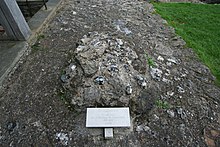
In June 2009, Pope Benedict announced excavation results concerning the tomb of Paul at the Basilica of Saint Paul Outside the Walls. The sarcophagus itself was not opened but was examined by means of a probe. It revealed pieces of incense and purple and blue linen as well as small bone fragments. The bone was radiocarbon dated to the 1st to 2nd century. According to the Vatican, this seemed to confirm the tradition of the tomb being Paul's.
Writings
Main article: Pauline Epistles
Fourteen epistles in the New Testament are attributed to Paul, of which seven are almost universally accepted, and seven are disputed, (Ephesians, Colossians, 2nd Thessalonians, 1st Timothy, 2nd Timothy and, Titus, and Hebrews), of which four are considered in some academic circles as other than Pauline for textual and grammatical reasons, and the other three are in dispute in those same circles. Paul apparently dictated all his epistles (except Galatians) through a secretary (or amanuensis), who would usually paraphrase[dubious ] the gist of his message, as was the practice among 1st-century scribes. These epistles were circulated within the Christian community, where they were read aloud by members of the church along with other works. Paul's epistles were accepted early as scripture and later established as Canon of Scripture. Critical scholars regard Paul's epistles (written 50-62)[citation needed] to be [among] the earliest-written books of the New Testament. They are referenced as early as c. 96 by Clement of Rome.
Authorship

Paul Writing His Epistles, 16th century (Blaffer Foundation Collection, Houston, Texas).
Main article: Authorship of the Pauline Epistles
Paul's letters are largely written to churches which he had visited; he was a great traveler, visiting Cyprus, Asia Minor (modern Turkey), mainland Greece, Crete, and Rome. His letters are full of expositions of what Christians should believe and how they should live. He does not tell his correspondents (or the modern reader) much about the life of Jesus; his most explicit references are to the Last Supper[1 Cor. 11:17-34] and the crucifixion and resurrection.[1 Cor. 15] His specific references to Jesus' teaching are likewise sparse,[1 Cor. 7:10-11] raising the question, still disputed, as to how consistent his account of the faith is with that of the four canonical Gospels, Acts, and the Epistle of James. The view that Paul's Christ is very different from the historical Jesus has been expounded by Adolf Harnack among many others. Nevertheless, he provides the first written account of what it is to be a Christian and thus of Christian spirituality.
Of the fourteen letters attributed to Paul and included in the Western New Testament canon, there is little or no dispute that Paul actually wrote at least seven, those being Romans, First Corinthians, Second Corinthians, Galatians, Philippians, First Thessalonians, and Philemon. Hebrews (no relation to the Gospel according to the Hebrews), which was ascribed to him in antiquity, was questioned even then, never having an ancient attribution, and in modern times is considered by most experts as not by Paul (see also Antilegomena). The authorship of the remaining six Pauline epistles is disputed to varying degrees.
The authenticity of Colossians has been questioned on the grounds that it contains an otherwise unparalleled description (among his writings) of Jesus as 'the image of the invisible God,' a Christology found elsewhere only in John's gospel. On the other hand, the personal notes in the letter connect it to Philemon, unquestionably the work of Paul. Internal evidence shows close connection with Philippians. Ephesians is a very similar letter to Colossians, but is almost entirely lacking in personal reminiscences. Its style is unique. It lacks the emphasis on the cross to be found in other Pauline writings, reference to the Second Coming is missing, and Christian marriage is exalted in a way which contrasts with the reference in 1 Cor. 7:8-9. Finally, according to R.E. Brown, it exalts the Church in a way suggestive of a second generation of Christians, 'built upon the foundation of the apostles and prophets' now past. The defenders of its Pauline authorship argue that it was intended to be read by a number of different churches and that it marks the final stage of the development of Paul of Tarsus's thinking. It has to be noted, too, that the moral portion of the Epistle, consisting of the last two chapters has the closest affinity with similar portions of other Epistles, while the whole admirably fits in with the known details of St. Paul's life, and throws considerable light upon them.
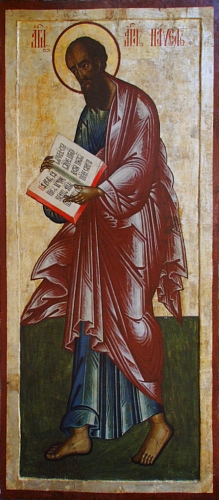
Russian Orthodox icon of the Apostle Paul, 18th century (Iconostasis of Transfiguration Church, Kizhi Monastery, Karelia, Russia).
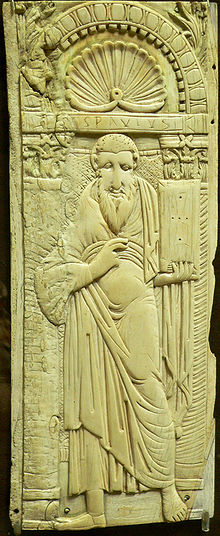
Saint Paul, Byzantine ivory relief, 6th - early 7th century (Musée de Cluny)
The Pastoral Epistles, 1 and 2 Timothy, and Titus have likewise been put in question as Pauline works. Three main reasons are advanced: first, their difference in vocabulary, style and theology from Paul's acknowledged writings; Defenders of the authenticity note, that they were then probably written in the name and with the authority of the Apostle by one of his companions, to whom he distinctly explained what had to be written, or to whom he gave a written summary of the points to be developed, and that when the letters were finished, St. Paul read them through, approved them, and signed them. Secondly, the difficulty in fitting them into Paul's biography as we have it. They, like Colossians and Ephesians, were written from prison but suppose Paul's release and travel thereafter. However, Christianity was not yet declared a religio illicita at the time they were written, and according to Roman law there was nothing deserving of death against him. Finally, the concerns expressed are very much the practical ones as to how a church should function. They are more about maintenance than about mission[citation needed].
2 Thessalonians, like Colossians, is questioned on stylistic grounds, with some[citation needed] noting, among other peculiarities, a dependence on 1 Thessalonians yet a distinctiveness in language from the Pauline corpus. This, again, is explainable by the possibility of St. Paul requesting one of his companions to write the letter for him under his instructions.
Atonement
Main article: Atonement in Christianity
Paul wrote down much of the theology of atonement. Paul taught that Christians are redeemed from the Law (see Supersessionism) and from sin by Jesus' death and resurrection. His death was an expiation; as well as a propitiation, and by Christ's blood, peace is made between God and man. By baptism, a Christian shares in Jesus' death and in his victory over death, gaining, as a free gift, a new, justified status of sonship.
Relationship with Judaism
Main article: Paul of Tarsus and Judaism
Some scholars see Paul (or Saul) as completely in line with 1st-century Judaism (a "Pharisee" and student of Gamaliel), others see him as opposed to 1st-century Judaism (see Marcionism), while still others see him as somewhere in between these two extremes, opposed to "Ritual Laws" (see for example Circumcision controversy in early Christianity) but in full agreement on "Divine Law". These views of Paul are paralleled by the views of Biblical law in Christianity.
Paul's theology of the gospel accelerated the separation of the messianic sect of Christians from Judaism, a development contrary to Paul's own intent. He wrote that the faith of Christ was alone decisive in salvation for Jews and Gentiles alike, making the schism between the followers of Christ and mainstream Jews inevitable and permanent. He argued that Gentile converts did not need to become Jews, get circumcised, follow Jewish dietary restrictions, or otherwise observe Mosaic laws. Nevertheless, in Romans he insisted on the positive value of the Law, as a moral guide.
E. P. Sanders' publications have since been taken up by Professor James Dunn who coined the phrase "The New Perspective on Paul" and N.T. Wright, the Anglican Bishop of Durham. Wright, noting a difference between Galatians and Romans, the later being much more positive about the continuing covenant between God and his ancient people than the former, contends that works are not insignificant but rather proof of attaining the redemption of Jesus Christ by grace (free gift received by faith)[Rom. 2:13ff] and that Paul distinguishes between works which are signs of ethnic identity and those which are a sign of obedience to Christ.
World to come
See also: Christian eschatology, Second Coming, End times, and World to Come
According to Ehrman, Paul believed that Jesus would return within his lifetime. He states that Paul expected that Christians who had died in the mean time would be resurrected to share in God's kingdom, and he believed that the saved would be transformed, assuming supernatural bodies.
Paul's teaching about the end of the world is expressed most clearly in his letters to the Christians at Thessalonica. Heavily persecuted, it appears that they had written asking him first about those who had died already, and, secondly, when they should expect the end. He assures them that the dead will rise first and be followed by those left alive.[1 Thes. 4:16ff] This suggests an imminence of the end but he is unspecific about times and seasons, and encourages his hearers to expect a delay. The form of the end will be a battle between Jesus and the man of lawlessness[2 Thess. 2:3] whose conclusion is the triumph of Christ.
Role of women
Main article: Paul of Tarsus and women
A verse in the first letter to Timothy, 1 Timothy 2:12 ("I suffer not a woman"), traditionally attributed to Paul, is often used as the main biblical authority for prohibiting women from becoming ordained clergy and or holding certain other positions of ministry and leadership in Christianity, though Paul's authorship of this letter is debated. The Letter to Timothy is also often used by many churches to deny women a vote in church affairs, reject women from serving as teachers of adult Bible classes, prevent them from serving as missionaries, and generally disenfranchise women from the duties and privileges of church leadership. The apparent message of this verse may seem anachronistic to 21st century Western societies with their emphasis on gender egalitarianism and non-discrimination
The KJV translation of this passage seems to be saying that women in the churches are to have no leadership roles vis a vis men. Whether it also forbids women from teaching children and women is dubious as even those Catholic churches that prohibit female priests, permit female abbesses to teach and exercise authority over other females. Any interpretation of this portion of Scripture must wrestle with the theological, contextual, syntactical, and lexical difficulties embedded within these few words. Fuller Seminary theologian J. R. Daniel Kirk finds evidence in Paul’s letters of a much more inclusive view of women. He writes that Romans 16 is a tremendously important witness to the important role of women in the early church. Paul praises Phoebe for her work as a deaconess and Junia who was (according to some scholars) an Apostle. Kirk points to recent studies that have led "many scholars" to conclude that the passage in 1 Corinthians 14 ordering women to "be silent" during worship was a later addition, apparently by a different author, and not part of Paul’s original letter to Corinth. Other scholars such as Giancarlo Biguzzi, claim that Paul's restriction on women speaking in 1Corinthians 14 is genuine to Paul but applies to a particular case of prohibiting asking questions or chatting and is not a general prohibition on any woman speaking since in 1Corinthians 11 Paul affirms the right of women to prophesy. Kirk's third example of a more inclusive view is Galatians 3:28: "There is neither Jew nor Greek, slave nor free, male nor female, for you are all one in Christ Jesus (italics added). In pronouncing an end within the church to the divisions which are common in the world around it, he concludes by highlighting the fact that "...there were New Testament women who taught and had authority in the early churches, that this teaching and authority was sanctioned by Paul, and that Paul himself offers a theological paradigm within which overcoming the subjugation of women is an anticipated outcome."

The conversion on the way to Damascus, by Caravaggio.
Influence on Christianity
Main article: Pauline Christianity
Paul's influence on Christian thinking arguably has been more significant than any other New Testament author. Paul declared that faith in Christ made the Torah unnecessary for salvation, exalted the Christian church as the body of Christ, and depicted the world outside the Church as under judgment.
Lord's Supper
Paul's writings include the earliest reference to the supper of the Lord, a rite traditionally identified as the Christian Eucharist.
Eastern tradition
In the East, church fathers reduced the element of election in Romans 9 to divine foreknowledge. The themes of predestination found in Western Christianity do not appear in Eastern theology.
Western tradition
Augustine's foundational work on the gospel as a gift (grace), on morality as life in the Spirit, on predestination, and on original sin all derives from Paul, especially Romans. - In the Reformation, Martin Luther expressed Paul's doctrine of faith most strongly as justification by faith alone. John Calvin developed Augustine's predestination into double predestination.
Modern theology
In his commentary The Epistle to the Romans (Ger. Der Römerbrief; particularly in the thoroughly re-written second edition of 1922) Karl Barth argued that the God who is revealed in the cross of Jesus challenges and overthrows any attempt to ally God with human cultures, achievements, or possessions. Some theologians believe this work to be the most important theological treatise since Friedrich Schleiermacher's On Religion: Speeches to its Cultured Despisers.
As in the Eastern tradition in general, Western humanists interpret the reference to election in Romans 9 as reflecting divine foreknowledge.
Church tradition

Statue of Saint Paul in Damascus.
Various Christian writers have suggested more details about Paul's life.
1 Clement, a letter written by the Roman bishop Clement of Rome, around the year 90 reports this about Paul:
"By reason of jealousy and strife Paul by his example pointed out the prize of patient endurance. After that he had been seven times in bonds, had been driven into exile, had been stoned, had preached in the East and in the West, he won the noble renown which was the reward of his faith, having taught righteousness unto the whole world and having reached the farthest bounds of the West; and when he had borne his testimony before the rulers, so he departed from the world and went unto the holy place, having been found a notable pattern of patient endurance."
Commenting on this passage, Raymond Brown writes that while it "does not explicitly say" that Paul was martyred in Rome, "such a martyrdom is the most reasonable interpretation."
Eusebius of Caesarea, who wrote in the 4th century, states that Paul was beheaded in the reign of the Roman Emperor Nero. This event has been dated either to the year 64, when Rome was devastated by a fire, or a few years later, to 67. The San Paolo alle Tre Fontane church was built on the location where the execution was believed to have taken place. A Roman Catholic liturgical solemnity of Peter and Paul, celebrated on June 29, may reflect the day of his martyrdom, other sources have articulated the tradition that Peter and Paul died on the same day (and possibly the same year). The apocryphal Acts of Paul, the apocryphal Acts of Peter suggest that Paul survived Rome and traveled further west. Some hold the view that he could have revisited Greece and Asia Minor after his trip to Spain, and might then have been arrested in Troas, and taken to Rome and executed.[2 Tim. 4:13] A tradition holds that Paul was interred with Saint Peter ad Catacumbas by the via Appia until moved to what is now the Basilica of Saint Paul Outside the Walls in Rome. Bede, in his Ecclesiastical History, writes that Pope Vitalian in 665 gave Paul's relics (including a cross made from his prison chains) from the crypts of Lucina to King Oswy of Northumbria, northern Britain. However, Bede's use of the word "relic" was not limited to corporal remains.
Paul, who was quite possibly martyred in Rome, has long been associated with that city and its church. Paul is the patron saint of London.
Critical views

Facial composite of Paul by experts of the LKA NRW, Germany.
Main article: Pauline Christianity
Elaine Pagels, professor of religion at Princeton University and an authority on Gnosticism, argues that Paul was a Gnostic and that the anti-Gnostic Pastoral Epistles were "pseudo-Pauline" forgeries written to rebut this.
British Jewish scholar Hyam Maccoby contends that the Paul as described in the Book of Acts and the view of Paul gleaned from his own writings are very different people. Some difficulties have been noted in the account of his life. Paul as described in the Book of Acts is much more interested in factual history, less in theology; ideas such as justification by faith are absent as are references to the Spirit, according to Maccoby. He also points out that there are no references to John the Baptist in the Pauline Epistles, although Paul mentions him several times in the Book of Acts.
Others have objected that the language of the speeches is too Lukan in style to reflect anyone else's words. Moreover, George Shillington writes that the author of Acts most likely created the speeches accordingly and they bare his literary and theological marks. Conversely, Howard Marshall writes that the speeches were not entirely the inventions of the author and while they many not be accurate word-for-word, the author neverthless records the gist of them.
F. C. Baur (1792–1860), professor of theology at Tübingen in Germany, the first scholar to critique Acts and the Pauline Epistles, and founder of the Tübingen School of theology, argued that Paul, as the "Apostle to the Gentiles", was in violent opposition to the original 12 Apostles. Baur considers the Acts of the Apostles were late and unreliable. This debate has continued ever since, with Adolf Deissmann (1866–1937) and Richard Reitzenstein (1861–1931) emphasising Paul's Greek inheritance and Albert Schweitzer stressing his dependence on Judaism.

A statue of Paul holding a scroll (symbolising the Scriptures) and the sword (symbolising his martyrdom).
Maccoby theorizes that Paul synthesized Judaism, Gnosticism, and mysticism to create Christianity as a cosmic savior religion. According to Maccoby, Paul's Pharisaism was his own invention, though actually he was probably associated with the Sadducees. Maccoby attributes the origins of Christian anti-Semitism to Paul and claims that Paul's view of women, though inconsistent, reflects his Gnosticism in its misogynist aspects.
Professor Robert Eisenman of California State University, Long Beach argues that Paul was a member of the family of Herod the Great. Professor Eisenman makes a connection between Paul and an individual identified by Josephus as "Saulus," a "kinsman of Agrippa." Another oft-cited element of the case for Paul as a member of Herod's family is found in Romans 16:11 where Paul writes, "Greet Herodion, my kinsman."
Among the critics of Paul the Apostle was Thomas Jefferson who wrote that Paul was the "first corrupter of the doctrines of Jesus." Howard Brenton's 2005 play "Paul" takes a skeptical view of his conversion.
F.F. Powell argues that Paul, in his epistles, made use of many of the ideas of the Greek philosopher Plato, sometimes even using the same metaphors and language. For example, in Phaedrus, Plato has Socrates saying that the heavenly ideals are perceived as though "through a glass dimly." These words are echoed by Paul in 1 Corinthians 13:12.




 Pope Benedict XVI was elected Pope in April 2005.